Pop-quiz: how do you identify the local coordinate system vs the world coordinate system?
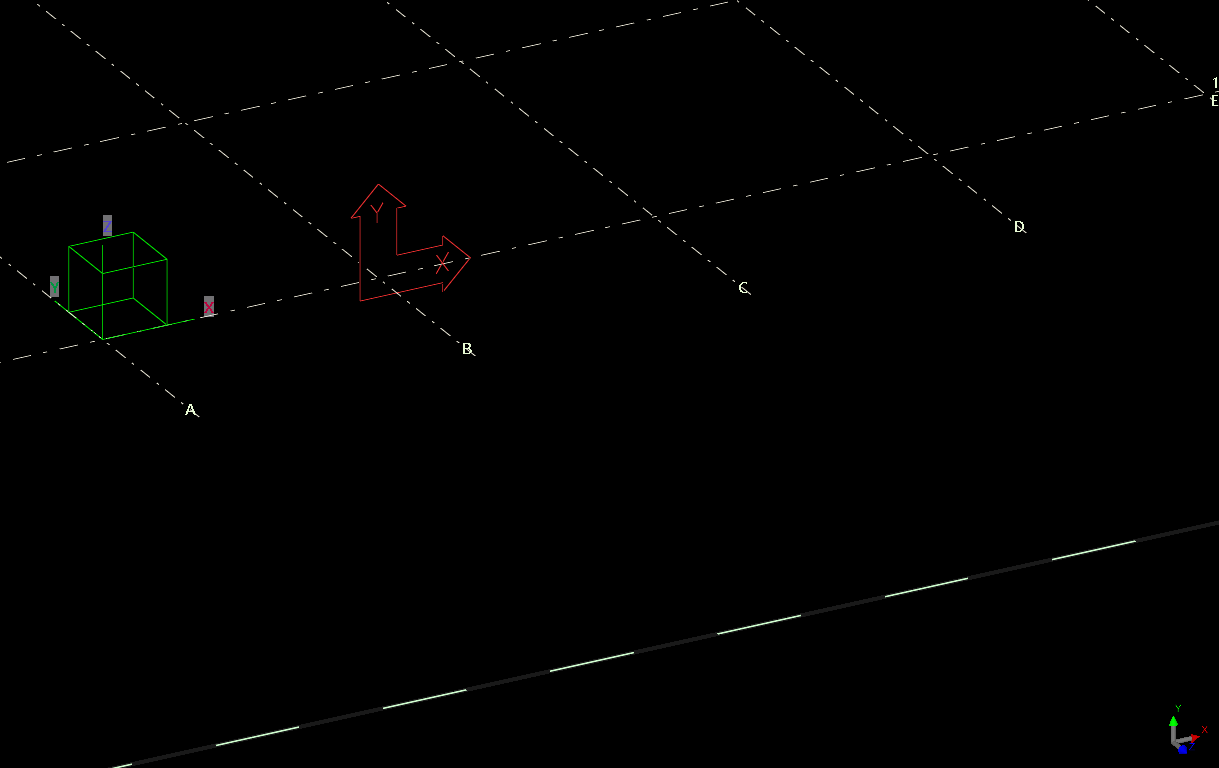
The answer is below:
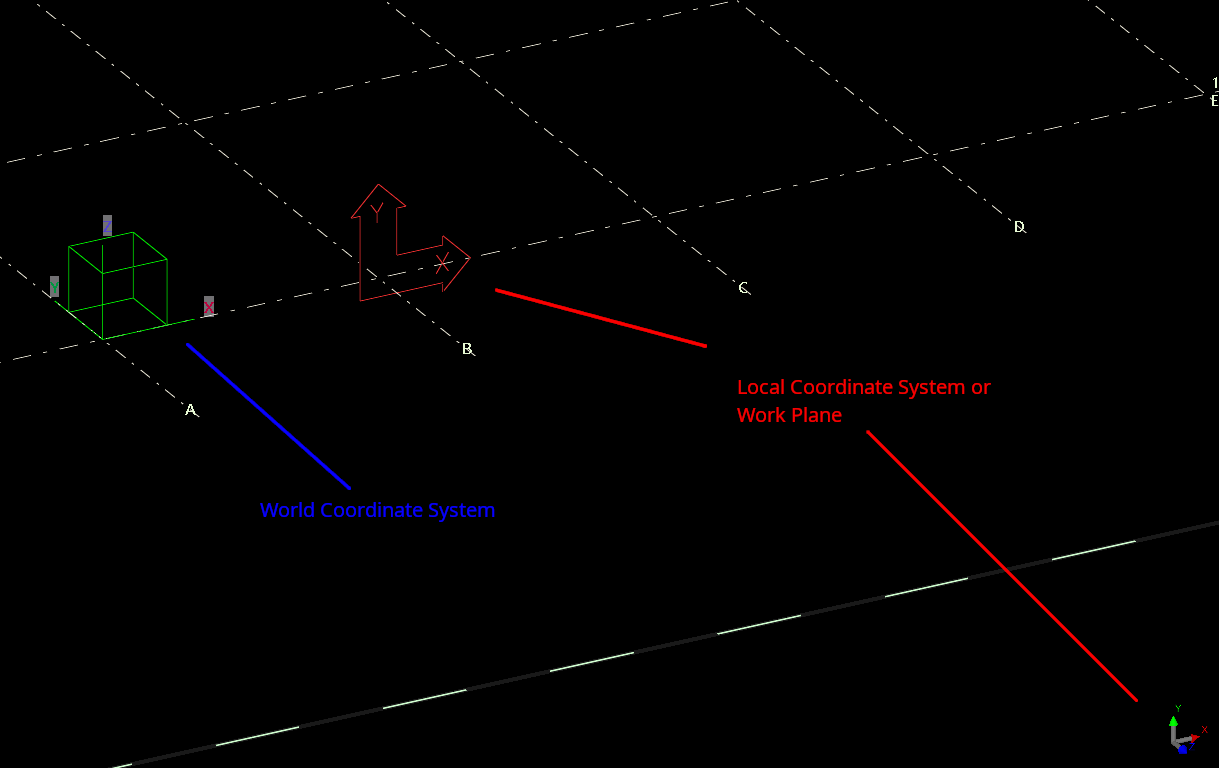
Green box denotes the WCS. The UCS is denoted in two places. The UCS is the “work plane”.
A series of blog posts exploring the Tekla API. Code examples, explanations and (where relevant) videos will be provided.
Pop-quiz: how do you identify the local coordinate system vs the world coordinate system?
The answer is below:
Green box denotes the WCS. The UCS is denoted in two places. The UCS is the “work plane”.

If you are inserting panels via the Tekla API, you need to be aware or have an understanding of the panel’s local coordinate system.
The x-axis denotes the vector from the start to end point.
This may be in stark contrast to a beam’s local coordinate system (or at least according to your intuition).
The Z axis represents the height of the beam.
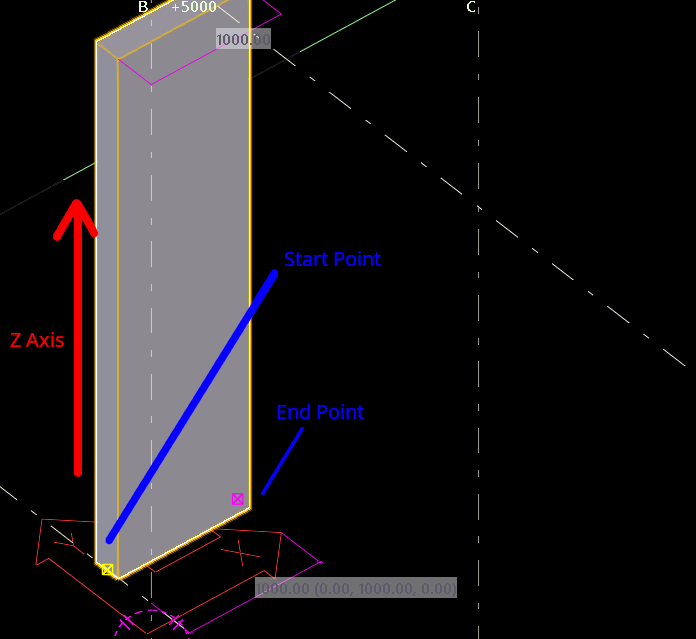
This is what you’ll get.
Try the following code sample:
Reference Links:
https://gist.github.com/benkoshy/3ca6f46564d348685097f1196767f86a
Checkout Tek1’s blog posts for more content on the Tekla Open API. https://www.tek1.com.au/category/tekla-api/
If you need to hire us to do your Tekla API work, please send us your proposal to [email protected]
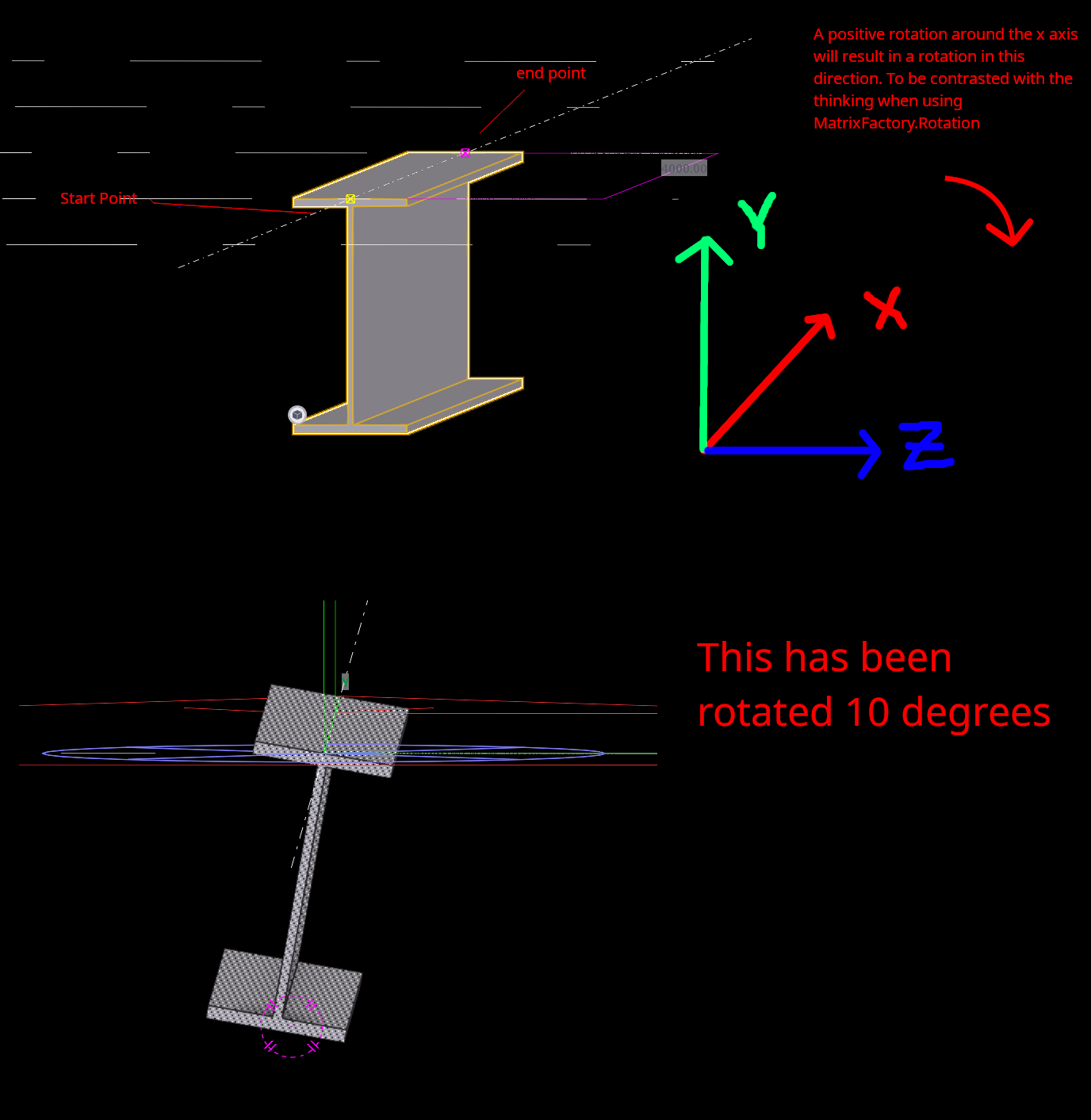
The documentation is perfectly opaque. As expected. What is the X and Y and Z axis in relation to a beam?
Easy. Check the picture.
Furthermore, now you also know what “Rotation” means in relation to a beam. Tekla does this because it is difficult for humans to define a beam using a change of basic matrix.
For more information on the code behind it, check out this post, or check out the extension methods I have published and open sourced
X vector of a beam is always the start and end point of the beam.
Checkout Tek1’s blog posts for more content on the Tekla Open API. https://www.tek1.com.au/category/tekla-api/
If you need to hire us to do your Tekla API work, please send us your proposal to [email protected]
Yet another Tekla API gotcha.
If you wanna waste many hours wondering why your code doesn’t work – try the Tekla API!
Here is a note for the benefit of the public – where they mutate objects – which SHOULD NOT be mutated. Perhaps they have their own reasons, but the general boy-scount principle(s) should apply:
They voilate both, IMO:
Working with the Tekla API is just unecessarily difficult!
Checkout Tek1’s blog posts for more content on the Tekla Open API.
If you need to hire us to do your Tekla API work, please send us your proposal to [email protected]
The documentation of the Tekla API – IMO is inadequate. That is why we need supplemental explanations and code samples.
Here is another example that hopefully benefits the community.
I have written a bunch of extension methods (Tekla.ExtensionMethods) that would hopefully simplify a lot of the headaches associated with using the API. This is already published as an Open Source project under an MIT license and is available on Nuget. As of 2026-06-25 it is released under an alpha release – meaning that the API might change drastically.
Checkout Tek1’s blog posts for more content on the Tekla Open API.
If you need to hire us to do your Tekla API work, please send us your proposal to [email protected]
This post and tutorial shows you how to set up your Tekla Dependencies (i.e. DLLs) on an Tekla Open API project:
Source code:
Directly Embedded code:
Model model =  new Model();

if (model.GetConnectionStatus())
{
    Beam beam = new Beam();
    beam.StartPoint = new Point(0, 0, 0);
    beam.EndPoint = new Point(1000, 0, 0);
    beam.Profile.ProfileString = "UB150*14"; // make sure this is available in your environment.
    beam.Finish = "PAINT";

    beam.Insert();


    model.CommitChanges();
}
Nuget Packages:
And if you prefer vimeo (i.e. if you hate youtube ads) checkout this link:
This is going to be a concise, high value and pithy course on the Tekla Open API.
You may find other courses out there that boast about: 50+ hours. That might work well for them and their students, but almost everything you need to know can be boiled down to a few simple concepts. Especially helpful if you are an engineer and wanting to automate a few simple tasks. For more specialised requirements that involves making API calls, or developing web apps, you want to a workflow that is engineered by a professional – whether by Tek1 or other parties.
The following documents the course.
Video Course:
Youtube Playlist of the Course (inclusive of all Tekla API related Material)
This is a course on how to program using Tekla’s Open API. We will start from the very beginning and get into some complicated topics. These are the principles I use when developing Tekla API applications.
The following posts a video tutorial on how to get started using the Tekla Open API. The first thing you need is visual studio.
Ensure you have enough memory on your C (or XYZ drive). If you do not have enough memory, then watch me trouble shoot this problem.
Getting Set-up:

The Code Behind the Shed Builder
As promised, here are the key methods behind the ShedBuilder:
I have separate classes – e.g. Facia, Column, Chord, Girt etc. to better represent the concepts and the interplay between all the items – and then I simply tie them all together to get the output that I want, but the main logic is here – if you wish to write the code yourself:
And to extract properties given a particular profile:
And finally to get all profiles which have a “HEIGHT” property:
The Key Libraries I use:
This is a live production / job example of how we can quickly / accurately detail sheds at scale.
Meaning we can handle:
(i) volume
(ii) speed
You can do the same too!
If you have questions or need assistance automating – feel free to email: [email protected] or [email protected] or visit our website: https://www.tek1.com.au/ or +61 0411 022 502 if you need to call me.
Or if you wish to develop the software yourself checkout our blog posts – where all the basic elements to create this type of automation is present.
For more posts checkout our Tekla API blog.